
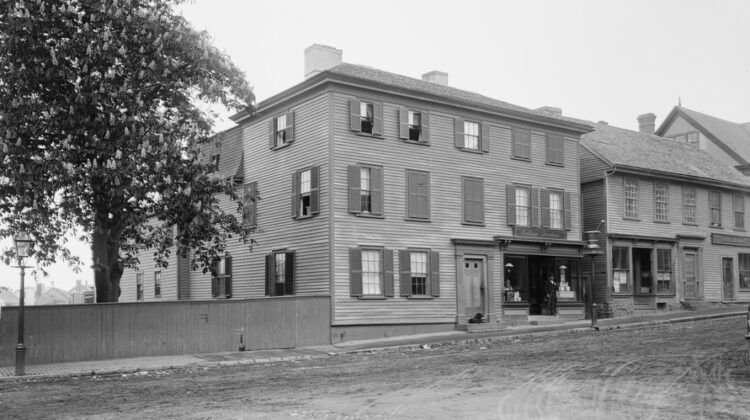
As a town steeped in history, Marblehead has many prominent figures who have significantly impacted the history of the United States. This statement remains true when speaking about Joseph Story.
Story was born in Marblehead on Sept. 18, 1779 to Elisha Story and Mehitable Pedrick Story. He was one of 18 children, according to the Supreme Court Historical Society.
Elisha Story, a doctor in town, was a significant figure during the Boston Tea Party. At the same time, his grandfather served in the British Vice Admiralty Court in Boston, eventually becoming the clerk of the American Navy Board.
Story’s maternal grandfather helped stop a British raid on munitions in Salem a few years before the American Revolution.
His whole life was steeped in history as he grew up surrounded by men who were not just a part of it but were helping to create it.

After his time in Marblehead Academy, Story would leave for Harvard, where he succeeded, graduating second in his class.
Story would become the apprentice of attorney Samuel Sewall, who had presided as a judge during the Salem Witch Trials and was the chief justice of the Massachusetts Supreme Court. The well-known Fort Sewall, located in town, is also named after him.
After multiple family tragedies, including the loss of his wife, Mary Linde Fitch Oliver, and the loss of his father just two months after, Story buried himself in his work.
The Society noted that while Story had thrown himself into his work, he struggled to get clients at first. His political affiliations and Unitarian religious beliefs weren’t popular in Massachusetts, which was dominated by the Federalist party.
However, his success in court and his association with businessman Jacob Crowninshield grew his clientele.
Story served in the Massachusetts and federal legislatures, briefly becoming speaker of the house for the Massachusetts House of Representatives in 1811. Here, he’d argue his first case in front of the Supreme Court: Fletcher v. Peck.
The Georgia Legislature had taken control of Yazoo lands, and the Yazoo Land Act of 1975 was enacted. However, it was found that those who had approved of the Act had taken bribes, ultimately leading to the legislature’s repeal, and the land purchases were voided.
Peck had purchased 13,000 acres of that land from the grant and sold it to Fletcher. It was then found out by Fletcher that the Land Act had been voided, leading Fletcher to sue Peck for the bad sale.
Story would take Peck as a client, and in the end, Peck would walk away clean, as he was proven to be an innocent third party.
The case gained prominence as it was the first time the Supreme Court had ruled a state law unconstitutional.
Story would go on to marry Sarah Waldo Wetmore, and two out of seven of their children would survive to adulthood. One was William Wetmore Story, who would become a famous sculptor. He even sculpted a statue of his father, which now sits in the Harvard Law School Library.
At just 32 years old, Story would make his next move up the career ladder as President James Madison would nominate him to the Supreme Court. He took the oath in 1812 and is still the youngest Associate Justice ever to serve.
Story embraced the idea that the Court was meant to protect and advance the power of the federal government, according to the Society.
It was Story who expanded the idea that the Court could reverse decisions made by state courts and the idea that federal courts could develop federal common law for commercial cases.
The Society also notes that Story fought against slavery, even writing the Court’s opinion in the 1841 Amistad, refuting claims that the captives transported from Africa by the Spanish government were property, ordering the men to be freed, claiming they were not slaves, but kidnapped.
However, in another decision, Story had made the choice to follow the United States’ law when he reinforced the federal Fugitive Slave Law during Prigg v. Pennsylvania.
The case centered around an enslaved woman named Margaret Morgan, who had not been formally emancipated but was granted full freedom by her owner, John Ashmore. Ashmore’s heirs called for her return, sending Edward Prigg to Pennsylvania to capture her and bring her back to Maryland.
The Fugitive Slave Law of 1793 overruled state law, allowing the capture of enslaved people who had escaped.
Story also joined the law faculty at Harvard in 1829 and would go on to write nine books on “the philosophy and legal bases of law.”
One future justice, Oliver Wendell Holmes, said that Story had “done more than any other English-speaking man in this century to make the law luminous and easy to understand,” according to the Society.
Story served on the Court for 34 years before he died in 1845, due to illness. His law writings and work on the Court “left a lasting impact on American jurisprudence. His writings advanced the theory of the supremacy of federal law. Justice Joseph Story is remembered as a serious constitutional and legal scholar whose nationalist vision of federal law was instrumental in strengthening the nation,” the Society noted.
